
Friday, October 18, 2013
Knowing—Growing—Sowing
Regarding our personal lives, it's good to ask ourselves every once in a while, "What the heck am I doing?" I get in such a groove with daily routines that I become stuck in a rut! Church is much the same: we go through the motions each week and, from time to time, try to remember the reason we're doing what we're doing (like I do these days when I go into a room, stop, and try to recall why I went in there!).
I am convinced that in our modern age of consumer church, by an ever-so-slight and a sometimes hard-to-recognize degree, we are veering away from the Church's simple yet profound original purpose: Helping to connect people with God.
This week, in the Wednesday morning men's meeting I attend at my church, I was thinking of our church's purpose in the community—these three words came to mind: to Know, Grow and Sow. It's probably cornball, and not at all original, but it reminds me that we should be all about people and not just designing incredible "big-top" extravaganzas of worship events each week. There is a place for worship services, music, preaching and fellowship in the life of our church (I just completed a 200-page book on the subject of worship), but to focus the majority of our fiscal budget, time and effort on producing events is out of balance.
To clarify: I am a proponent of killer music, excellence, and the "if you're gonna do it at all, do it the best you know how" approach. I love quality lighting because it helps me see what's onstage; I like good sound because it helps amplify even the smallest and most nuanced part of a sermon or musical arrangement; I like hi-def video because it helps me see the words to the worship songs, and I can be encouraged by my pastor's preaching in our Spring Hill auditorium, which is broadcast from our main campus, 20-minutes away in Franklin—and it can be seen at a later time online, too. Living in Tennessee, I am so very thankful for air-conditioning. I don't wanna go back to funeral fans and opened windows for comfort!
I am all for technology and the advancements that God has engineered to assist the Church throughout the centuries. But we must remember our primary purpose: to Know God and help others get to know Christ personally (through church services, events and outreaches and "circle-of-influence"-evangelism, etc.); to Grow spiritually (through various spiritual formation initiatives— from classroom learning to old-school one-on-one mentoring); and to Sow the Gospel and go into all the world, as the Great Commission commands (not suggests!). We are called to work along side God to help re-create in others what He has created through Christ in us. Ultimately, it's about fostering a community of people to (as the Westminster Shorter Catechism states): "...glorify God, and to enjoy Him forever."
I think there's probably a place for Christ-followers to sit in a comfortable building, watching the "pros" do church each week for an hour and a half. But as we refocus our purpose, the work of the Church is not for the professional Christians alone to accomplish. Rather, it's for every church staff member and volunteer believer, both young and old, to join together in the business of Knowing, Growing and Sowing!

Monday, October 7, 2013
Goodbye Pastor Chuck Smith
It was sad to hear the news of Chuck Smith's passing. For decades he was Senior Pastor of Calvary Chapel Costa Mesa, California. He slipped quietly away from his family and flock to be with the Lord last week, after an almost two-year battle with lung cancer. Chuck was 86.
 I know that, ultimately, the death of a Christ-follower is a victory: we shed our mortal bodies to inhabit new, glorious ones that will never again experience struggle, sickness or pain. I watched Chuck's final sermon last week online. He preached in that old familiar sanctuary that I visited so many times back in the mid-'70s. Chuck made his way to the pulpit and sat while he spoke, an oxygen tube affixed to his nose to help him deliver a message on keeping the faith. No one knew at the time that this would be his last sermon from the pulpit. Looking at the video from that fateful Sunday morning service on September 29th, it was bittersweet.
So many came to the Lord over the years and grew mightily through Chuck's ministry at Calvary Chapel. I came to know the Lord and, in part, grew in my own faith through the ministry there. I am grateful that when the opportunity arose to minister to those shaggy-haired hippies back in the late-'60's and '70s, he said, "Yes!" While so many would turn their backs on the hippies, Chuck welcomed them into Calvary Chapel's fold. Many were barefooted, unkempt and unshaven—many of Calvary's members counseled him against it. His decision to reach out to those counter-culture dropouts helped set the wheels in motion for one of the greatest cultural revivals in America, not to mention the incredible Jesus Music and the subsequent worship renewal that was birthed out of it all.
Bittersweet—yes—because it's an end of an era for believers of my generation from the West Coast. Chuck made sure to raise up several leaders over the years who, in turn, helped plant several churches all over the world and disciple millions. The work will continue as those young leaders, many former hippies from the early days of Calvary Chapel, following Chucks example, duplicated themselves and raised strong leaders for successive generations.
God is honored through the life of Chuck Smith. I don't want to waste a single day messing around with worthless pursuits, and I would like to end my days knowing I finished the race as well as he did.
Tuesday, October 1, 2013
Worship Teams: Leading A Volunteer Army

Thanks for faithfully coming back to these pages each week, and I hope you've gained encouragement through the writings.
***
The best currency for volunteers is appreciation. It’s important to convey appreciation during and after each event. It’s also good to have “hi-five” moments when an event goes over well, and equally important to make necessary corrections, with love, when something doesn’t go as well. Volunteers want to be a part of something exciting, life-changing, and carried out with excellence and efficiency. As a leader, it’s my responsibility to bring direction and discipline to the whole process. Volunteers want to feel respected, protected and appreciated.
Becoming an effective leader is a life-long process, and it’s important to invest in leadership, as well as spiritual and musical training. This book will speak of leadership throughout, but there are so many resources available in Christian bookstores. Books by contemporary authors such as John Maxwell and Bill Hybels, and even classics like “D.L. Moody on Spiritual Leadership” are available in print or in e-book form. There are seminars such as the annual Willow Creek Leadership Summit, simulcast from the Chicago-area main campus to local churches throughout the world. Training videos are available on the Willow Creek website to help you become a more effective leader.
"Volunteers want to feel respected, protected and appreciated."
It’s not too late to finish your college or graduate degree. There are many universities that offer online courses on leadership. The opportunity to complete what you may have started years ago can be invigorating. Any investment that makes us a better person, leader, minister, and musician is a good one.
Jesus’ Method of Leadership
Jesus made sure the disciples knew that the true essence of leadership was being a servant. He taught them through the humble task of washing the disciples’ feet. Even though some relented, Jesus pressed-in to make His point. In John 13:12-16, we see Jesus, the ultimate servant, in action:
“When he had finished washing their feet, he put on his clothes and returned to his place. ‘Do you understand what I have done for you?’ he asked them. ‘You call me ‘Teacher’ and ‘Lord,’ and rightly so, for that is what I am. Now that I, your Lord and Teacher, have washed your feet, you also should wash one another’s feet. I have set you an example that you should do as I have done for you. Very truly I tell you, no servant is greater than his master, nor is a messenger greater than the one who sent him. Now that you know these things, you will be blessed if you do them. (NIV)’”
There is no greater display of true leadership than in the life Jesus. His way of dealing with people, prioritizing His time (He did what He was called to do in roughly three years), and making courageous and unpopular decisions, is a great example of true focus, passion and purpose. His obedience to God is our example to emulate. His behavior inspires us to get up, get out and be the leader we need to be. Our understanding of people, human nature, and how to inspire a diverse team of individuals, with a focused goal, is imperative to effective leadership.
Monday, September 23, 2013
Worship Is the Whole Enchilada
It seems obvious, but it's a good reminder that worship is why we were created. It's fitting, on this beautiful Monday morning, to start our week with this statement from the Westminster Shorter Catechism :
Man’s chief end is to glorify God, and to enjoy him forever.
Every human through time has had this in common—though many today don't realize it yet, or have walked away from God, knowing this Truth full well.
All of Life
Worship isn't limited to singing or the song set before the sermon. Rather as an act of continual prayer, worship is meant to fill each moment of every day (1 Thessalonians 5:17). Our bodies were intended to be temples of worship (1 Corinthians 6:19-20) and, according to Scripture, every believer is a priest, whose duty is to bring sacrifices to God (1 Peter 2:9). We offer ourselves to God in worship—living sacrifices, holy and pleasing to Him (Romans 12:1-2).
The priests of the Old Testament took turns serving in the Temple, facilitating worship 24-hours a day. The role of the priest in the Old Testament was to minister to God on behalf of the people and minister to the people on the behalf of God. Now, even in this modern post-New Testament era of worship, we must, like the Temple priests, serve God and worship Him on a continual basis. So, worship is meant to be an around-the-clock exercise. During our day, as we go about our business, we offer our joys, our fears, our jobs, our friends, our family, our wills, and our future to Him as we worship.
The Worship of God is Virtue (our highest purpose in life)
Virtue is not only equated with moral excellence, goodness and righteousness, but with purpose. In classic philosophical terms (teleology) it means: to fulfill the purpose for which something was created. In other words:
—The virtue of a hammer is to drive or extract nails
—The virtue of a guitar is to create music
—The virtue of lawn mower is to cut grass
If we misuse something—an acoustic guitar to drive a stake in the ground, for instance—the guitar will most likely end up in splinters, and the stake will probably not have budged an inch. Living in sin—deliberate disobedience to the known will of God—is a misuse of our lives, and it's the direct opposite of virtue. Sin leaves us empty, frustrated and bereft of the good things God intends for us. Walking away from God leaves us broken and splintered like the acoustic guitar. But instead, if we invest our lives in the purposes of God, walking with Him and exalting Him daily, we are changed, and the world around us will be affected.
Since we were created to exalt God and fellowship with Him, worship is the ultimate virtue for humanity. Therefore in worship, we are fulfilling our true purpose—mentally, spiritually and physically.
_______________________________________
This is an excerpt from my new book, Worship Foundry, to be released on WestBow Press/ Thomas Nelson by the end of the year. Please check back for updates and come back often to read my blog! Blessings to all!
Tuesday, September 17, 2013
When God Says No
My big, self-inflicted assignment this week was to clean and rearrange my office. Part of this mammoth project was to empty out my gargantuan desk and move it to the garage, awaiting my son-in-law to take and use in his law office.
Last night Brenda was all ready to help me in this endeavor, but in the morning she woke up with one of those killer, once-a-year migraine headaches. My plans for the office and her plans to pray at church needed to be altered. We did manage to get some of the office stuff taken care of after her pain medication kicked in. When we sat down to rest afterward, Brenda reminded me of how God has changed our plans several times in the past through intuition or a pain of one kind or another. I look back through my life and remember the times when God said "no." Even though it wasn't the answer I wanted at the time, I'm now so very thankful for it.
It's hard to hear "no," especially when you're a 12-year-old and your dad says you can't go to the skating rink on Friday night with the older kids. It's hard to hear "no" when you've gathered the courage to ask a girl out on a date and she turns you down. It's hard to see your plans fall apart when you're set to purchase the home of your dreams and, for some reason, it goes to another buyer.
As an adult, I've learned to listen to God through His still, small voice—and even the bombastic voice that comes through discomfort or by way of an uneasy feeling. "No" and "yes," for that matter, can be communicated clearly if we really listen close.
When Brenda and I were first married, we took a trip to New Orleans and found ourselves wandering off the beaten path and into a dank back alley of the French Quarter. We both felt strangely uncomfortable and sensed the instinctive need to bolt out of there, away from the shadows and the creepy spiritual vibes that seemed to reach out to us like ghostly fingers in the darkness. In fact, we ran straight to our car and left! I guess it was the goat skull and the satanic symbols that hung in a window of an old apartment that seemed to project the foreboding message: "You don't belong here!"
God usually gives us the choice to stay or flee. Many times we blame God for the consequences after diving headlong into questionable situations. The fact is, our gut can tell us a lot, and God gave us our instincts for a reason.
I read today about a recent study of participants who were forced to choose between two options based on instinct alone; they made the right call up to 90 percent of the time. Regarding the results of this study, Mark Prigg, science and health writer for the Daily Mail, writes: "Professor Marius Usher of Tel Aviv University's School of Psychological Sciences and his fellow researchers say their findings show that intuition was a surprisingly powerful and accurate tool." The findings showed, "Intuitively, the human brain has the capacity to take in many pieces of information and decide on an overall value...[and that] gut reactions can be trusted to make a quality decision."
Sometimes a headache can seem troublesome. Maybe, though—just maybe—by way of the intrusion, God is keeping us from a calamity that we would never have expected. Back in the day, when our parents told us "no," we most likely didn't understand. But it's only after becoming adults, after developing a higher sensitivity to instinctive warnings, that we understand it's for a very good reason—for our own good.
God doesn't have to explain Himself to us as he drags us by the scruff of the neck, back to the curb, just in time for an unseen car to whisk by and miss us by inches...there's simply not enough time! When God says "no," He wants to protect us, not disappoint us; He wants to bless us, not withhold from us. He may have a "yes" waiting in the wings—but we may have to wait just a little longer for it.
Wednesday, September 11, 2013
The Cheese Factory: A lesson in self-reinvention

"Sniff and Scurry are mice—non-analytical and non-judgmental, they just want cheese and are willing to do whatever it takes to get it. Hem and Haw are 'littlepeople,' mouse-size humans who have an entirely different relationship with cheese. It's not just sustenance to them; it's their self-image. Their lives and belief systems are built around the cheese they've found. Most of us reading the story will see the cheese as something related to our livelihoods—our jobs, our career paths, the industries we work in—although it can stand for anything, from health to relationships. The point of the story is that we have to be alert to changes in the cheese, and be prepared to go running off in search of new sources of cheese when the cheese we have runs out."I've been self-employed my whole career, and if anybody knows about running out of cheese, it's me! It's so important to flow with the seasons in life. One of the biggest mistakes that people make—and believe me, I've made many— is to wait until it's too late. The secret, as the book's message clearly provides, is to stay ahead of the curve.
I've witnessed two country artists who, even in the face of a changing music market and diminishing record sales, refused to surrender after their "cheese supply" started to dry up; these two guys are a study in self-reinvention.
Ricky Skaggs helped start the neo-traditional movement as a country performer in the eighties and maintained a high place on the music charts for over a decade. A new generation of artists emerged in the nineties who took country music toward a more pop sound. As a result, and after much soul-searching, Skaggs decided to return to his bluegrass roots. He also left his record company to start Skaggs Family Records, began to actively embrace his elder statesman role on the Opry, and continues to keep a busy touring schedule. Skaggs recently released a recording with Bruce Honsby and a new autobiography.
Over a decade ago, Marty Stuart decided to embrace his elder statesman role as well, and in recent years, has started his own TV show on a small cable network. Over time, Marty gained the respect of country music fans and professional musicians alike not only for his incredible talent, but also because of the high-caliber musical guests on his show. He gained new fans in the process—ones that probably never knew his music when he was climbing the charts as a young artist. Stuart's current band, The Fabulous Superlatives, are top-notch pickers and singers—solo artists in their own right, who've released music on Marty's own Superlatone Records label. Marty has one of the largest country music memorabilia collections on the planet, including priceless show costumes and instruments from country music's greatest stars. He has a packed concert schedule, and is considered by many—along with Skaggs and Vince Gill—to be a foremost country music ambassador.
Not bad for a second wind! These guys didn't wait for country music to come to them; they created their own music industry—what an inspiration.
As the "cheese" book suggests, it's probably wise to follow Ricky and Marty's lead and create a "cheese factory" all our own. Instead of waiting around for an invitation to do what we love (and for which we are highly skilled), let's make a plan, set some goals and head out with excitement toward the next season of life. That's what I'll be doing, my good friends!
Tuesday, September 3, 2013
The Power of Blessing
I saw a few weeks back that Ricky Skaggs, probably my all-time favorite country/ bluegrass artist, had a biography coming out. It's been informative and entertaining. The book takes the reader through the backwood streams and "hollers" of bluegrass history, involving Ricky's upbringing and rise to fame, with stories of early bluegrass pioneers, including his heroes Ralph Stanley, and Bill Monroe in particular.
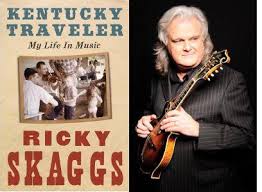
The sweetest and most tender part of the book, in my opinion, comes in its last quarter. By this time, around the mid-'90s, Ricky's record sales had dropped considerably, compared to his "high cotton" days of chart success during the '80s. As a born-again Christian since his teens, Ricky had by this point recommitted his life to the Lord. Now he and wife, Sharon, were hosting prayer meetings in their home. On one particular night, Skaggs invited Bill Monroe, the Father of Bluegrass, over to one of the meetings. Monroe agreed to come, but when it was time for the couples to break out and pray, Monroe, who came alone, didn't have a prayer partner. So he asked Ricky and Sharon if they'd pray for him.
Skaggs revered Bill Monroe all of his life—ever since he was a little kid and first heard that old 1923 Gibson Loar F-5 mandolin pounding away over the radio from the Grand Ole Opry. He even got to play that very mandolin when Monroe visited his eastern Kentucky community for a local school house concert, and the inventor of bluegrass himself pulled the then 6-year-old Ricky up on the stage to play.
 |
| Bill Monroe's mandolin. |
Now, thirty-plus years later, Ricky stood there before the elder statesman, and this time he asked Mr. Monroe to pray a blessing over him. Ricky explains that he got on his knees at Monroe's feet and asked him, "'Would you bless me like a father blessing a son; would you pray that I'll be a caretaker of this old music?'" Monroe agreed, bowed his head and said these words over Ricky—ones that he'd never forget: "'Lord, would you just give Ricky the love for the old music, like you've given me through the years, and help him carry it on? Bless him and his family.'" Ricky went on to say,"With his hands laid on me, he gave me his blessing. (p.283)"
Speaking a blessing over someone doesn't have to be a sophisticated, fancy event, or a verbose statement filled with theological phrases and religious mumbo-jumbo. It is a powerful gesture of love, faith, hope and belief in someone. I believe everyone has the power to bless, and it's something that is said verbally and not inferred; it's spoken clearly to those we bless, and not left for interpretation. Even telling someone "I love you" or "I'm sorry" is a blessing in itself.
The spoken word is powerful. I want to use my words to leave a positive legacy in people's lives, especially within my own family and to those with whom I work closely. Lord, help me speak a blessing to someone today!
Subscribe to:
Posts (Atom)